Growing Pains

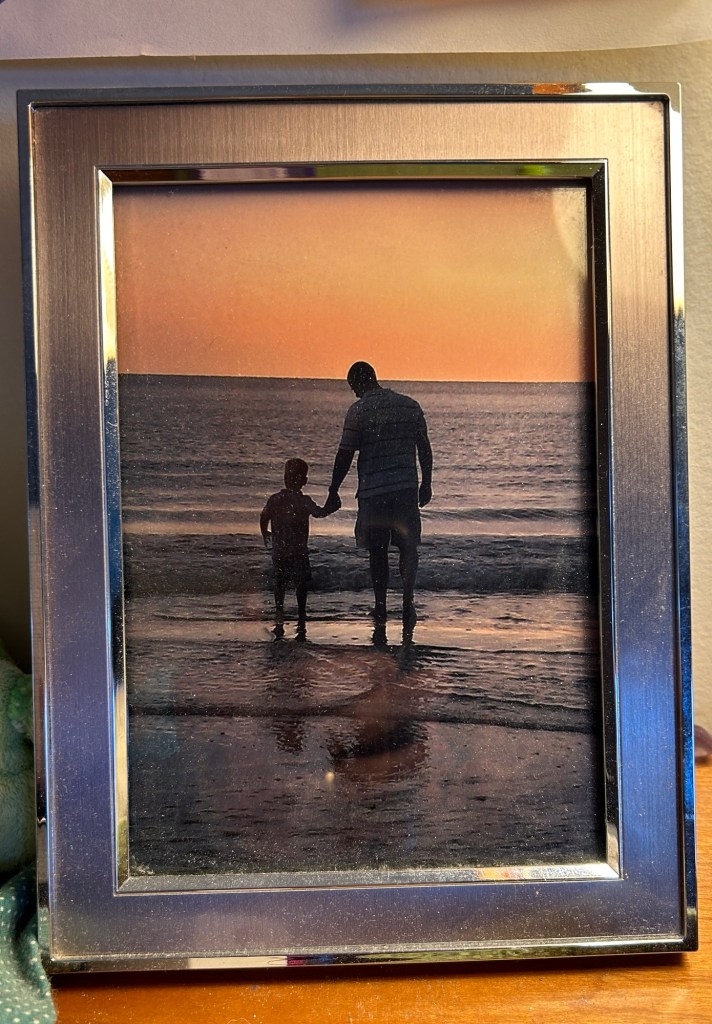
I keep a picture on my nightstand, the centerpiece of what my wife half-jokingly refers to as my “shrine” to my son. It was taken on our first family vacation to Florida when he was only five years old. We are standing facing the water, the sun setting in the background over the Gulf of Mexico. I am holding his small hand in mine, probably tighter than necessary, as he takes his first steps into the vastness of the ocean.

When my son was about six months old, I opened a college savings account in his name. Years later, my wife confessed that she had been irritated with me at the time, thinking that I was moving too fast in planning so far ahead into the future. Truthfully, during this period I had no idea how I was going to raise this helpless infant into a man, and picturing him as a teenager headed off to college was nearly impossible for me.  But I have always been one of those people who look further down the road, checking the traffic ahead, planning and anticipating the choices I might need to make as I move through the world. This quality served me very well as a police officer and especially as a sergeant. In my personal life, it has been as much a burden as it has been a positive feature, and fatherhood challenged this part of me in ways I could not have imagined. 

When my son was two and a half, my wife decided to return to her own career after an almost four-year absence. Dead set against using daycare, we both agreed to work opposite shifts so that he would always be with one of us. This resulted in many things; lost sleep, a greatly extended tour for me on the night shift, but most of all the blossoming of a new and deeper relationship between me and my son. At around 12:30 pm on most days, I would arise from bed after working the night shift, and begin my day with my son as my wife left for work.  As a primary caregiver, I was woefully unprepared and inept at first, the bulk of daily functions of child care having mostly been expertly and lovingly performed by my wife while I worked as much overtime as possible. But I learned quickly, and soon I discovered a bond with my son that was both unexpected and magnificent. For the last fifteen years, that bond has only grown stronger and more rewarding. 

This past Spring, we began the search for a suitable college as my son would be graduating high school the following year. Intent on playing football in college, he had only the criterion that the school must have a good football program. As he has never been overly fond of school, I took what positives I could from this as any motivation towards higher education was welcomed. As we began our search and the reality of his approaching departure started to sink in, I began the painful process of trying to figure out what my world would look like without my son in it every day.

My own experience entering the college years was vastly different from my son’s. By the time I reached my senior year of high school, my father had been without a job for over two years and was deep in the throes of his addiction to alcohol. He was mostly absent from my life and contributed little to the financial stability of our home. My mother would constantly complain about how we had no money, and that my sister, two years ahead of me and already a sophomore in college, would have to drop out because there wasn’t enough money for tuition. I only visited a handful of schools that Fall, several of them by myself. Each visit left me wondering how I would pay for my education. Eventually, I settled on a local community college to save money, working after school and on the weekends to help pay my tuition.  

The trips my son and I have made to the various colleges he has shown interest in have been some of the greatest and most powerful experiences of my time as a father. At each school, we have met with professors, advisors, coaches, and players. There have been overnight stays, football camps, long drives, and many restaurant meals. I have prized every minute I have been given with him on these trips and my insight into who he is and the amazing young man he is becoming has continued to grow. 

Being my son’s father has been one of the greatest joys of my life, despite the occasional hardships that parenting can bring. Perhaps the greatest challenge I have faced as my son has reached his late teens is the seemingly simple task of letting him go. Possibly because I felt I was let go so easily, I have a strong need to keep him close, protect him, and make sure that he is OK. In my heart, I know that this will not serve him in the long run, and I struggle daily to resist my impulses. The psychologist Jordan Peterson likened the challenge to the biblical story of Abraham and Isaac. Abraham is commanded by God to sacrifice his beloved son Isaac to show his obedience to God. Parents, if they hold their children’s best interests at heart, must, in a way sacrifice their children, perhaps not to God, but to the greater world. Not doing so would ultimately be a great injustice to the child, the world, and the parents as well. 

That once tiny hand I held on the beach that day now dwarfs my own, it’s owner now grown into an almost 6’4” 290 pound offensive lineman, on his way to play Division One college football. There is a part of me that will always want to hold on to him as he faces the challenges and uncertainties of the world, though I know in my heart that he has to face it all alone at some point if he wants to become a man. It is not lost on me that he may be more ready for this task than his father. 
Deadly Force

I was 23 the first time I almost shot another human being. I and a fellow rookie officer had responded to a bland suburban neighborhood for a “welfare check” on a middle-aged woman who lived alone on a quiet residential street. Her mental health struggles were well known in the neighborhood and to many from my department who patrolled her area. The call had come from a postal worker who had become concerned after seeing a large pileup of mail at the house. Finding the front door open, my partner and I, calling out loudly as we entered, began to methodically search the large two-story home, first searching the ground floor, then the basement before heading to the second floor. As we ascended the stairs, we continued calling out “police officers, is anybody here?” Making our way down the darkened second-floor hallway, we cautiously approached the last bedroom, its door ajar and a light visible from within. Carefully I peeked quickly around the frame of the door and into the room, my pistol held in both hands as nervous sweat dripped from my face. 

She was sitting upright on the bed, a rifle cradled in her arms, its muzzle pointed at the doorway. The shock of seeing the rifle caused me to jump back, shouting “gun” to my partner as we retreated from the door. We began shouting for her to throw the gun to the floor, but received no response. Gathering our courage after taking several minutes to regroup, we again approached the door, using a method known as “slicing the pie” to slowly gain a view of the room without exposing ourselves to gunfire. Eventually, we maneuvered into a position where we could see the woman. She had not moved, and her right hand was draped loosely around the grip of the rifle, her finger near, but off of the trigger. In her eyes, I saw no recognition, no awareness of her surroundings, just the blank stare of someone who was catatonic. We eventually entered the room and took her safely into custody after first pinning the rifle to the bed and then pulling it easily from her grasp. Unloading a live round from the chamber, I reflected on how close we had all come to tragedy. A short while after, she was at a local hospital receiving mental health care, and we were back on patrol as if nothing had happened. 

There is a scene in the movie “The Departed” where the character Billy Costigan, portrayed by the incomparable Leo DiCaprio, sits with a court-mandated psychiatrist for counseling after he has been arrested for assault. Their conversation turns to her other patients, and he soon learns that she counsels police officers after they have been involved in shootings. In a voice dripping with scorn, Costigan laughingly tells her that “they signed up to use their weapons,” echoing a sentiment that is certainly shared by many, particularly in the racially charged times we live in today. I do not doubt that many police officers do, at least at first, glamorize and mythologize the possibility of having to use deadly force. I know I certainly did. But the passage of time and the grim reality of what those incidents actually look and feel like, both during and after, often eclipses any of what TV and movies portray of police shootings.

In the police academy, new officers are taught from day one that the world they are entering is dangerous, where felons intent on bodily harm lurk around virtually every corner. Sometimes this is not far from the truth. One friend who worked as a cop in a notoriously violent southern city spent his first day at the academy viewing a slide presentation of morgue photos depicting every police officer from his department murdered in the line of duty, accompanied by the lurid details of each killing. He described to me the repeated horror of seeing each smiling academy portrait next to the subsequent grisly death photo. The juxtaposition of the slain officers’ fresh-faced innocence with their bloody death masks was too much for some, and several recruits quit the academy that day.  That same friend went on to become involved in four shootings in his career, the first occurring only nine months after he pinned on the badge. The average age of a police recruit when I came on the job was about 21, and most of my 88-member academy class were as naive and inexperienced as that age would suggest. In our innocence, we absorbed like sponges the sometimes deadly knowledge we were given. 

Firearms training begins soon after the start of the academy, and the deadly seriousness of it is immediately clear. Recruits participated in live fire target practice on a shooting range as well as simulated combat against live adversaries and “shoot/don’t shoot” scenarios in a large video simulator. After six months of training, we left the academy for field training, where each officer is paired with an “FTO” or field training officer. The average FTO period lasted 16-20 weeks, with officers rotating through various patrol areas and work shifts, each rotation bringing a new training officer. Throughout this period, the necessary indoctrination into the “real world” of policing continued, with the lessons of the academy reinforced over and over, sometimes by the FTO, and often by the job itself.

Released from training to solo patrol after 20 weeks, it is the task of each rookie officer to somehow make sense of the awesome power represented by the badge he wears and the gun on his hip. If he or she is a thinking person, any illusions about the reality of using deadly force will soon be dissipated as experience is quickly gained in the uncontrolled environment they now inhabit, usually alone. Gone are the movie-inspired fantasies of a glorious shootout with an escaped felon or bank robber, with accolades and awards to follow, replaced instead by a more bleak and mundane truth.  

The check-the-welfare call I described is one probably all too familiar to many experienced police officers and is far more representative of the types of circumstances often leading to deadly encounters with police. America is in the midst of a mental health crisis, and police are frequently placed at the very forefront of it, often with limited training and resources. I have thought about that woman many times since that day early in my career. By law, I was justified in shooting her, and I am sure some officers might have done so. Perhaps I would have as well on a different day, or with a few small details or perceptions altered. What I am sure of is this; I did not want to shoot her, and I am grateful that I was not forced to. I would encounter many other scenarios over the course of my career where deadly force might have been justified, none however resulted in a shooting, as is the case with the vast majority of police officers in the United States. 

Police work is most often about judgment, timing, training, and, unfortunately, luck. Over the years, I was present at several officer-involved shootings, and I have many friends and others very close to me who have been forced to make this awful decision. I have yet to meet a single officer who was glad to have gone through it. Some were able to put it behind them, while others struggled for years with the aftermath of what they had to do. Like a stone thrown into a pond, these events send ripples through an officer’s life that reverberate for years to come. For those still skeptical, the statistics do not lie. The average police officer leaves police work entirely within three years of having been involved in a shooting. Despite what the media or certain critics of police may wish us all to believe, the simple truth is that the enormity of what happens in the aftermath of a shooting is often too much for most police officers to bear. 

Be Kind

Arriving at the battered trailer home, I wasn’t expecting much. Domestic calls were routine in this mobile home park, and the caller, a downtrodden looking woman about 35 years of age, had requested assistance getting her boyfriend and his brother to leave the trailer after they had all started arguing about the boyfriend’s drinking. “They’re both in there,” she said, gesturing towards the front door with a wave of her hand. “I just want them out, he’s been drinking all day and I know what that means for later.” After confirming how many people were inside the trailer and the status of any weapons secreted within, I asked the woman to wait down the street, and with her permission I opened the front door and stepped inside, announcing my presence as I did so. 

     As I entered, the familiar smell of deeply ingrained dirt, spoiled food, and pet odors assaulted my nose. I quickly spotted the woman’s boyfriend seated at a small kitchen table. He was a rodent-faced, slightly built man, with a half-finished bottle of beer in front of him and a sullen look on his weathered face. “Who else is here,” I asked, looking around the dim interior. “Nobody,” he replied, setting off alarm bells in my head as I recalled his girlfriend’s accounting of who was in the house. I asked him a second time, and without looking at me, he responded again that he was alone. As I began to question him further a deep voice boomed from the bedroom at the rear of the trailer. “I’m in here, boss.” Telling the boyfriend to wait outside, I walked down the short hallway to the last door, nudging it open with my foot as I stood back from the opening. 

   Carefully looking in I saw him sitting on the edge of the bed, his massive frame causing the mattress to sag noticeably in the center. He was at least 300 pounds, perhaps six feet tall, blue-black prison tattoos peeking from his collar and long-sleeved sweatshirt sleeves.  “Sorry, boss wasn’t trying to hide out on you or nothing.” I watched his eyes as he sized me up. Still a new officer, and at a point in my career where I was filled with the foolish confidence of youth, I was not intimidated by many people. But this guy was built like an NFL lineman, and his telltale use of the term “boss” told me he had done prison time, as inmates often used that term for correctional officers. After getting his name and birthday from his license, I decided to be cautious, cheerfully but forcefully telling him there was no trouble but he would have to leave the trailer. To my surprise, he complied, raising his considerable bulk from the bed and walking ahead of me down the narrow hall to the door. To our surprise, his brother had already left. He stood outside the trailer looking down the road for a moment, then slowly trudged off towards the park exit.

     Once he was safely out of earshot, I radioed dispatch and gave them his information, asking for a “29 check” which is radio jargon for criminal history. A short time later the dispatcher called on the radio, asking me if my suspect was within hearing distance. After I advised her that he was not, she informed me of an outstanding parole warrant my suspect had. I requested another car to meet me near the entrance. After a few minutes my backup was there, a highly capable officer I was always happy to see, especially when circumstances might turn sour. We headed for the road where my warrant suspect had walked shortly before, quickly locating him at the exit to the highway. He looked at me with some surprise as I pulled up, clearly sizing me up again and looking at the second deputy with detached interest. Telling him he had a parole warrant, I told him to turn around and put his hands behind his back. To my surprise, he did so after only a moment of hesitation.

Later, as I completed the prisoner data sheet to be completed whenever a custodial arrest is made, I asked him about his prison history, and what he had served time for. He explained without emotion that he had just finished serving 18 years in various New York State prisons after he had shot someone in a home invasion robbery. He went on to say that all of his time had been served in so-called “gladiator schools,” a prison term for facilities known for their high level of violence. Asking if he had any notable tattoos, he proudly showed me the markings of the prison gang for which he had served as an enforcer, carrying out stabbings and beatings on the behalf of the “shot callers” above him. When I asked him about any identifying scars, he laughed and said, “too many to count.” “Biggest one,’ I replied. He looked at me without expression then wordlessly tilted his head back, exposing an ear-to-ear scar on his throat, clearly the result of an assault. Genuinely curious, I asked him who could have possibly accomplished this given his formidable size and fearsome reputation. He laughed again and said it was a “5 foot 5 Puerto Rican dude with a razor blade” who had done it, then showed me several more scars, all the result of prison assaults. For the next hour, he regaled me with hair-raising prison stories while we awaited the arrival of his parole officer with the warrant. At one point, I asked him why he had not resisted arrest, as he was easily a match for two cops given his tremendous size and obviously extensive experience with deadly violence. He looked at me through the cage and responded simply; “you talked to me like a man, you treated me with respect.” I nodded and returned to my paperwork. Soon after, his parole officer arrived and we were off to the jail for booking. Thankful for the non-violent outcome of our interaction, I left him there a short time later, reflecting as I did so on how the smallest interactions can spiral into so many different possible endings.

Respect, such a simple concept, is often difficult to give on both sides of the line in policing. Constantly dealing with angry, intoxicated, stressed, scared people can leave you raw and angry yourself, sometimes unable to see the people you deal with as mostly the same as you, human, despite their behavior. This of course does not preclude caution, and respecting the basic dignity of others must always be balanced with a keen eye for one’s own safety, but the old adage “tread lightly on old toes” brings added significance here. A veteran sergeant once told me, “A little respect will get you a long way in this job. Leave your ego at the door, and remember, you never know whose toes you’re stepping on, so be kind, until it’s time not to be.”

Don’t Blink

My son turned 16 the other day. It’s funny how time can pass unnoticed. One day you are holding your newborn baby for the first time, and the next you are making plans to get him his driver’s license. The intervening years, which sometimes seemed to go by so slowly, suddenly feel like a blur. My hands still remember encircling his sturdy little frame as I lifted him into his car seat on a long-ago October afternoon. Now those same hands have to reach up to pull him in for a hug, that sweet toddler now a 6’3” 275-pound offensive lineman.

A few weeks ago, I sat in the stands as my son and over 100 other boys completed full contact drills at a two-night summer football camp. Each year after all the drills are over, the coaches get together and award T-Shirts to a handful of the boys who showed the most improvement and a good work ethic. Hearing my son’s name called, I watched with pure joy as he jumped happily to his feet and trotted eagerly forward to receive his shirt. After shaking the coach’s hand, he turned and began to make his way back to his teammates, a proud smile covering his face. I looked on as he paused for a brief moment, clutching the T-Shirt to his chest as he scanned the bleachers until he found me, waving quickly as he made eye contact. I gave a wave and a thumbs up back as I fought to control my emotions. 

One unexpected byproduct of becoming a parent for me has been the unavoidable contemplation of my difficult childhood. As I watched my son looking for me, I remembered searching the stands for my father at various athletic events. I rarely found him there. I have always made being present in my son’s life a priority, not out of obligation but out of a real desire to be a part of his world, to share in his victories, and to support him when he stumbles. It is truly the smallest moments that define our lives, and I see that day in the stands as a gift of inestimable value. The child in me still struggles with reconciling why I was somehow not important enough to my father for him to feel the same. Each milestone that passes in my son’s life bears an echo of another one missing in my own, from learning to throw a football or tie a tie to my first shave, and countless others. All were passed either alone or with a poor substitute. 

Before becoming a police officer, I worked for a year at a juvenile correctional facility. Much has been written about the crisis of fatherlessness in our communities. Few experiences can more poignantly illustrate the damage done by a father’s absence than a job working with incarcerated boys. Assigned to a disciplinary housing unit, I worked with a partner supervising an average of 22 boys between the ages of 13 and 19. Many were convicted of serious crimes including murder, and virtually all had a history of violent behavior. In the course of my year there I only encountered one boy from an intact home where a father was present. Few had any relationship whatsoever with their fathers, some did not even know who their fathers were. Most had sought the brotherhood of street gangs as a poor substitute for the family connections they had missed. Lost, angry, and confused, they would bluster, threaten, and fight, grasping for a way to make sense of their approaching manhood and the feelings they wrestled with. Once, in a moment of rare candor, one boy confessed to me that sometimes he would fight with staff just to receive physical contact from someone. 

As a young police officer, I would continue to see these same dynamics play out in the homes of the young men and boys I would interact with. Psychologists believe that in the absence of solid parental figures, the presence of a mentor or role model can weigh heavily in saving a child from total ruin. In many instances, this person takes the form of a coach or teacher. A person who guides, rewards, and demands accountability can work wonders for a child with no viable role models at home. I experienced this firsthand in my own life and attribute much of whatever success I have attained to the influence of several coaches who worked with me as a young man. As I have gotten older I have continued to seek out role models to help guide my behavior and actions, and I encourage my son to do the same. There is no one blueprint to becoming a man, but many fine examples exist to show him what a man looks like. I hope that he takes the best from all of the men he interacts with, including his father, and leaves the rest behind. 

I read a quote recently about being a parent; “Your children do not belong to you, they are delivered here through you to live their own lives.” At times this idea terrifies me, probably because deep down I know it to be true. I struggle each day with the fear that comes from surrendering my control over someone that I so dearly love. Each day I give a little more of him to the world, and a little bit less of him remains with me. A part of me will always see my son as that little boy happily extending his arms to me as I pick him up, or unselfconsciously holding my hand as we walk through a crowded shopping mall. Watching as he searched for me in the stands that evening, it was that small boy that I still saw, searching for, and finding his father.

Nothing can prepare you for how fast it all goes. They tell you, of course; “Don’t blink, you’ll miss it.” But there is simply nothing that marks the passage of time more starkly than watching the growth of your own child, and it must be experienced to be understood. It has been my honor and privilege to be my son’s dad. Raising and caring for him has made me a better man and a more complete human being. It is my greatest wish that more men could heal, rise to the task of being a father, and allow themselves to feel this way about their own children. 

A Woman’s Intuition

“He’s going to kill me.” She stated it flatly, without emotion, the resignation in her voice somehow more unnerving than fear would have been. “He’s going to kill me and there isn’t anything you can do about it.” She was a plain, sad-looking woman, and at 45 she seemed old to me, just 25 and only two years on the job. She looked at us with a defeated expression on her face, glancing nervously into the house from time to time to assure herself that her eleven-year-old son was not listening, her other son, nineteen, already away at college.

We were standing on the front porch of her modest suburban home, my sergeant and I, filling her in on the last-minute details of the domestic violence investigation we had completed involving her and her husband. We had just returned from serving a protective order on her estranged husband, who she had finally agreed to have arrested for domestic violence after years of emotional and physical abuse. The order was a “stay away,” and had been accompanied by a mandatory gun removal, the man’s modest gun collection now safely contained in the trunk of my patrol car.

My sergeant, a veteran of perhaps 18 years in police work, attempted to placate her, assuring her that the vast majority of these incidents were resolved without further violence once police became involved. I listened attentively, nodding as if I had the experience to even agree. She looked at us both, and in a tired voice, said “you’ll see. You don’t know him, but you’ll see.” Still, flush with the confidence of youth and inexperience, I believed somehow that the order of protection we had just served would serve its purpose, and, with our help and that of our victim assistance counselor, this woman’s life would soon take a turn for the better.

In the movies, when an abused woman flees a violent husband, it is often portrayed as some sort of clandestine adventure as she escapes with her children and begins her new life. But real life is not so romantic. Like most women trapped by an abuser, our victim on that day had almost no access to money. She had no credit, and only a part-time job as a hairdresser to pay the bills. Her suburban prison had been carefully built by her husband, a violent man who I would later learn was a true narcissist. We left her that day with reassurances that she was safe, with the admonition to call 911 immediately should her husband show himself at her door.

It was only a few days later, on my night off when he returned. Armed with a cheap 12 gauge shotgun he had purchased at a nearby gun store, he stood outside her kitchen window on the cool fall night, watching in silence as his wife did the dishes. He then placed the shotgun barrel on the glass and fired a single round of buckshot into her face through the window. Her eleven-year-old son, only steps away into the bathroom brushing his teeth, found his mother, and called 911. She died there, on her kitchen floor, a few minutes later as officers tried in vain to administer aid.

He was arrested a few hours later, after a brief standoff at his parent’s home in a neighborhood a few miles away. He had already retained an attorney, an expensive and highly respected criminal defense lawyer intimately familiar with the justice system. With the help of a convincing psychiatrist and his lawyer’s expert ministrations, a deal was eventually worked out, and he was sentenced to 8-25 years in prison for Manslaughter.

There is a rather cruel joke sometimes heard in police circles, “in New York, if you kill your wife on your wedding night, you’ll be out of jail by your twentieth wedding anniversary.” The joke, if one could even call it that, is regrettably rooted in reality. Fifteen years after he shot and killed his wife in front of their eleven-year-old son, the man was paroled back to the community. His parents, who had remained steadfastly by his side throughout his arrests, deeded their spacious suburban home to him in their will. He still lives there today, unencumbered by debt or financial worry.

The courts, acting on behalf of his surviving children, did terminate his rights to visitation despite his protestations. I find it difficult to be too congratulatory here of our justice system, even a broken watch is right twice a day. To the best of my knowledge his sons never spoke to him again, though I doubt that this troubled him at all.

What is it in the male psyche that goes wrong, that takes something as powerful and beautiful as the love one can have for a spouse and turns its warmth into venomous hate? Is it an evolutionary tic, a flaw in the system that causes these men to snap when control is wrested from them? “If I can’t have you, no one can” was a phrase I heard countless times over my police career, though only from the mouths of men. I eventually stopped trying to reason with them, and would instead spend extra time speaking to their victims, warning them of the very real danger that they could be killed after leaving.

I have written about domestic violence here before, and most likely will again. It is a featured performer in the story of most police careers, my own included. To be clear, men are often the victims of domestic violence, and I witnessed many of these tragic scenes over the years. But the statistics do not lie. In America, an estimated one-third of the women murdered each year are killed by an intimate partner. Following the O.J. Simpson trial, vast changes were made in many police departments around the United States regarding the prosecution of domestic violence cases. Despite these measures, the court system has remained out of step, failing to aggressively prosecute and jail violent offenders.

Somewhere in America, right now, a woman is telling somebody, a friend, a co-worker, a police officer, that her intimate partner is going to kill her. And she is right. Will we listen?

The Last Exit

For as long as I can remember, I have been an avid reader. Once, on a trip to the pediatrician’s office for some childhood ailment, I happened upon a collection of short stories, primarily moral and religious tales of the type frequently encountered in the 60s and 70s. Each was accompanied by detailed illustrations. One story, called “Jesus Understood,” was of particular interest to me. It involved a young boy hospitalized after being struck by a car. Bedridden and in terrible pain, he lay in his bed as another young patient explained to him that if his pain was too great, all he had to do was raise his hand as he went to sleep, and Jesus, who came to the ward each night, would see him and take him to heaven. That night, the boy carefully propped up his arm with a pillow and went to sleep. When morning came, he was dead, taken to heaven by Jesus.

In my 8-year-old mind, a plan began to form. Though not in physical pain, I deeply identified with the wounded boy in the story. I was an isolated, lonely child, made fearful of the world by turbulent and unpredictable circumstances at home. I had few friends and lived a life mostly inside my own mind, waiting and carefully planning each day for the next obstacle I would have to overcome. Captivated by the idea that I could simply leave my present existence and reside in heaven with Jesus, I decided to emulate the little boy in the story. That night after I went to bed, I carefully propped up my right hand with a pillow, just like I had seen in the picture. Falling asleep, I awaited with the faith of only the very naive an end to the pain of my day-to-day existence. 

Awakening the following morning, I was crushed. Thinking that I might have done something wrong, I persisted for several nights, each morning bringing fresh disappointment. I finally gave up; my faith was now challenged for the first, but not the last time. Realizing that nobody was coming to save me, I somehow found the will to move forward, slowly acclimating to the struggles that life brought me. As I grew older, I never forgot this period of my life or the depth of despair I felt. As a young adult and as a man, I would often find myself adrift in similar waters, and each time I would reflect on that 8-year-old boy, his failed plan, and the eventual parting of the clouds, revealing a brighter day.

Police officers often see more suicides than almost any other manner of death. Suicide is an epidemic in the United States, with just under 46,000 occurring in 2020. It is widespread among men, who commit suicide at 3.5 times the rate that women do. I would guess that I attended perhaps fifty suicides throughout my career, though the number may indeed be higher. I can recall one bleak week in the mid-1990s where I investigated four in as many days, one for each day I worked. All were attended by grieving family members, lost in the unique and excruciating pain that suicide brings to survivors. 

I would come to know many people over the years who made frequent suicide attempts, though most of these were women who tend to be more tentative in their approach and, in my experience, often call for help before or during the act. This reaching out frequently leads to rescue and, in some cases, successful treatment for the underlying mental illness that causes so many suicides. Men, who are more likely to use firearms and much more reluctant to ask for help, were far less likely to be saved. 

I always profoundly sympathized with victims of suicide that I encountered, both those who committed the act and loved ones left behind. More than a handful did it out of desperation following a terminal illness diagnosis. They were often unable to cope with chronic pain or simply feared the slow death awaiting them. But the overwhelming majority were escaping a different type of pain, one that I knew all too well. Sometimes the demons that haunt us can cause anguish as great as any physical disease, a pain that no drug can obliterate. 

The most awful part of these investigations was speaking to the survivors, who are often left with questions that can never be answered. Those contemplating suicide will frequently give hints, but rarely in my experience, will they express their intention once the decision has been made. Often survivors cannot see that they could not have prevented the act, and the guilt they are left with can be crushing. Suicide often runs in families, as children see it as a viable solution when parents make this terrible choice. I have also seen it become “contagious” in adolescent groups, with clusters happening in middle and high school. 

They say that the suicide rate among police officers is roughly twice that of the general population, and I do not doubt this number. I have personally known several policemen who chose this path, including one of my first training officers. The close, constant proximity of firearms combined with continuous exposure to the finality of death is a potent combination. Death can seem almost peaceful if you can somehow drown out the anguished cries of loved ones left behind. But it is a false promise. While I believe medically assisted suicide should be a legal option in some cases, I remain unconvinced that it is the solution most seek. 

I have no interest here in judging anyone for their choices or quantifying their pain, for, in the end, the only thing we truly own is our life. Who am I to disapprove of another’s decision over the only thing they truly and completely possess? I can only offer my own perspective as an observer of suicide and the devastation it leaves in its wake. To those who are contemplating it, you have only my compassion. I would ask only this: you do what I did as an 8-year-old boy and search for a way to get out of bed one more time. One day the clouds might begin to part for you too. 

Can You Keep a Secret

Cassandra Clare once wrote, “Lies and secrets…are like a cancer in the soul. They eat away what is good and leave only destruction behind.” When I was in college, I worked as a paid intern at a local police department alongside my closest friend. One afternoon as we worked filing papers in the criminal records office, he jokingly suggested that we look up family members to see if they had ever been arrested. In those days, all local arrests were kept in an enormous index card file, with all arrestees divided up alphabetically. Laughingly I began scrolling through the names until my fingers froze as I found my father’s name alongside the address of the home I grew up in. 

I took his booking number and walked on unsteady legs to the arrest folders’ shelves, my eyes quickly settling on my father’s. Opening it, I saw the multiple entries, bail records, booking sheets, all stemming from various DWI arrests my father had been subject to during my childhood. I looked numbly as my father’s face stared drunkenly back at me from his mug shot. My friend, now ashamed of his idea, attempted to console me as I correlated the various dates with my father’s times mysteriously absent from the house during my younger years. All of these arrests, some resulting in jail time, had been hidden from me by my parents.

My father’s alcoholism permeated every facet of my life as a child. His unpredictable moods, unexplained absences, and utter detachment from his family shaped me into the adult I would become. When I found out about his arrest record, I had already been estranged from my father for years. My tolerance for his behavior and the pain it brought, abundant as a boy, had long since been exhausted. We would reconcile briefly a few years later after he finally got sober, the tenuous relationship we had built then quickly cut short by his death at 57 from a brain tumor only a few years later. 

The deep shame that surrounds substance abuse in families is almost ubiquitous. As astonished as I was that my mother had withheld my father’s arrests from my sister and me, her secrecy should not have surprised me. I grew up in a house of secrets and lies. One Sunday afternoon, when I was about 8 or 9, I asked my father to bring me to the mall to buy a pocket knife I had saved my money for. Still too young to effectively understand and gauge my father’s level of intoxication, I missed the many warning signs as I approached him in the den, where he lay on the sofa watching a football game. ‘Can we go to the mall now like you promised?” I asked, hesitating as his red eyes met mine. “No,” he replied sullenly, probably aware of his drunkenness and inability to drive, his gaze already returning to the game. I began to cry as I walked away.

My mother, already busy preparing dinner in the kitchen, appeared in the doorway and began admonishing my father, telling him that he should not break his earlier promise to me. Looking back, I am still stunned that she could have done this, given that she was undoubtedly aware of how drunk he was. Sufficiently chastised, my father rose unsteadily from the couch and mumbled for me to get in the car. Happy in my ignorance, I ran to get my money and hurried to the garage. We were at Sears a short time later, and my new pocketknife was in my hands. As we made the short trip home, my father rear-ended the car ahead of us as we approached a red light. Jumping from the car, he met the other driver in the road where the two men briefly spoke before hurriedly exchanging information and returning to their vehicles. In later years I would surmise that the other driver had possibly been drunk, neither man wanting the risk of police involvement. As he got back into the car, my father quickly swore me to secrecy, imploring me not to tell my mother. I agreed, anxious to win his approval, and I said nothing when we returned to the house. 

That evening, after my mother noticed the damage to my father’s car, she sat me down at the kitchen table and interrogated me about what had occurred that afternoon. Remembering my promise, I held fast to my story, insisting that nothing had happened. Then, she changed tactics, adopting a confiding tone as she told me, “you know your father is a drunk, right? Can’t you smell the liquor on his breath? He’s an alcoholic.” Unsure of the meaning of her words, I shook my head numbly as she sent me off to bed, exasperated with my naïveté. Years later, now a father myself, I still look back in astonishment at her utter disregard for my safety and well-being that day.

Throughout my childhood, I was regularly reminded to keep what went on behind the doors of our house a closely guarded secret. My father’s mysterious absences, now so easily explained, were simply not spoken of. His alcohol and pill addiction were our private shame. My parents finally separated once and for all when I was 11, their divorce following a year later as I entered middle school. It was a full year before I shared this information with anyone, even a close friend. It was not until my senior year in high school that friends began to slowly open up their own inner worlds that I realized how typical my experience was. 

The trouble with keeping secrets is that you can never truly gain perspective or understanding, both for yourself and the experiences of others. We all strive to keep up appearances, to not show any weakness. Nobody wants to be singled out as being different. In our urgency to avoid this, we fail to take the opportunity to see how our own struggles really are not that dissimilar from those of others. When I began my career as a police officer, I quickly realized how many people are struggling just to get through life, how many are touched in some way by tragedy or heartache. I have stood in million-dollar mansions, quiet suburban tract houses, in rotting trailers, and roach-infested apartments while listening to identical tales of sadness, addiction, and abuse. Truly nobody has the market cornered on pain. How liberating would it be if we all could acknowledge that? How freeing would it be to stop not only judging others but to stop fearing their judgment of ourselves and our experiences. 

Lather, Rinse, Repeat.

When a new police recruit attends the police academy, a great deal of time is spent training new officers on how to deal with one of the most commonly encountered calls; domestic violence. It is widely accepted that calls involving family violence are exceptionally high risk. The reasons for this are apparent; emotions run extremely high in conflicts between romantic partners and family members. Often, emotions can be turned against the police responding to settle these disputes, some of which have simmered for years. 

Perhaps one of the hardest lessons for new police officers is how to deal with the volatile relationship dynamics present when dealing with domestic violence calls. In an instant, emotions can turn quickly, especially after seeing a loved one led away in handcuffs. Learning about the “cycle of violence” that often exists in dysfunctional domestic relationships is one thing. Seeing it play out before your eyes in real-time is quite another. 

Police officers are often portrayed as jaded and unsympathetic in dealing with these scenarios, and I do not deny that some are indeed insensitive and uncaring. Rates of domestic violence within the profession are higher than that of the general population, and this no doubt plays a role in some cases. But I suspect that there is another more human factor at work. The process of responding, often at significant risk, repeatedly, to the exact location, to deal with the same offender and victim can be exhausting, and at times come to feel almost pointless. Add to that a legal system that remains mainly indifferent to the serious problem of domestic violence, and you have a recipe for disaster. 

One afternoon, early in my career, I experienced a call that at the time seemed quite unique. However, as the years passed, calls like it would come to seem more and more routine. Dispatched to an apartment complex for a violent domestic dispute, my district partner and I raced through heavy mid-afternoon traffic as our dispatcher frequently updated us on the status of the call. A female caller, staying on the line with 911, was relaying information about her roommate’s boyfriend as he attempted to force his way into the apartment through a first-floor window. The caller stated that she was in the apartment with her roommate and her young daughter. As we drew closer, the updates grew grimmer, the boyfriend now inside the condo, choking the victim on the floor of the kitchen. As we pulled into the apartment complex, dispatch advised that they now had an open line, with screaming heard in the background.

As we entered the vestibule leading to each individual apartment, the suspect, apparently unaware of our arrival, ran from the apartment and directly into our path. A knockdown fight ensued. Reeling drunk and quite strong, the suspect resisted violently as we managed to pull him to the ground and wrestle him into a set of handcuffs. It was at that point that I heard a woman’s voice screaming, “don’t hurt him, I love him.” Looking up, I saw a young woman standing over me, her face contorted in rage. “Let him go,” she screamed at me, “I don’t want him arrested.” Even in the dim light of the entryway, I could easily see the marks on her face and neck where he had beaten and choked her. I ignored her for the moment and, with my partner’s assistance, dragged the still struggling suspect to the cage in my partner’s patrol car, where I left the two of them to go back inside. 

Entering the apartment, I first spoke to the victim, asking her permission to have the ambulance crew I had summoned come inside to check her out. Glaring at me, she nodded in assent, initially refusing to speak to me. While the ambulance crew treated her, I talked to the woman who had called us, explaining that I would need her statement as a witness. She quickly agreed and sat down to give me a deposition as her roommate angrily looked on. Finishing up, I turned to the victim. I asked if she would be willing to also give me a statement, explaining first that I was making the arrest under my own authority and that her cooperation, though it would be beneficial, was not needed. She refused at first but then seemed to have second thoughts as she realized that I, not she, would be signing the arrest paperwork. 

As we spoke, the bleak picture of her life began to unfold. The daughter of a police officer, she had moved out at age 18 and started a series of failed relationships, culminating at age 23 with her current one, which had produced their daughter, now age 2. She eventually confided that the abuse she had suffered today was a regular occurrence in her home and alluded to having seen her mother suffer similar abuse when she was a child. She went on to say that she had never had her boyfriend arrested before. I thanked her for helping me with the arrest paperwork and made my exit. 

A short while later, we were in front of a local judge. I requested bail and a “stay away” order of protection, both of which were quickly granted, and soon we were on our way downtown. My ride to the jail was punctuated by insults and curses from the back seat. My prisoner enraged that he was getting locked up, venting his outrage on me. Gratefully handing him over to the booking deputies, I left the jail and went back on patrol, already beginning to feel sore from the fight. After finishing my shift, I thought a little more about the encounter, comfortable knowing that the perpetrator was in jail where he belonged.  

A few weeks later, as I patrolled the apartment complex where the incident had taken place, I spotted the suspect, beer in hand, barbecuing steaks on a small grill outside the woman’s apartment. Seeing my approach, he waved mockingly, his mouth twisted into a smirk. Running a quick check through our records office, I learned that the order of protection I had asked for had been rescinded days earlier at the request of the victim, who had paid her boyfriend’s bail only a day after his arrest. Within a few weeks, the district attorney dropped all of the charges. All of my hard work and the considerable risk my partner and I had taken were simply disregarded. I felt disgusted and disillusioned.

I suspect there is no experienced cop alive who does not have a litany of stories similar to this one. I know I collected many more of my own as the years went by. Regular domestics were sometimes called “frequent fliers” by the cops on patrol, who often grew so familiar with some families they were on a first-name basis with victims and suspects alike. The frustration that comes from dealing with the same problem over and over, with no resolution, can become maddening. And some cops are unfortunately ill-equipped to deal with that frustration and maintain their professionalism. Cynicism creeps in, and the public suffers. 

While none of this is an excuse for any dereliction of duty, it can and should serve as instructive for those most critical of our legal system and the police, who are its most visible feature. Police are human beings. When all aspects of the system they work under do not act with a shared mission, failure is the result. In the case of victims such as the one I described, courts can and should maintain orders of protection despite protests from victims, who are often intimidated by their abusers into asking the courts to rescind these orders. District attorneys must press for jail time when there is violence involved in a domestic incident. Counseling should be made available as well, but incarceration is a must. Charges brought by police as opposed to victims should be pursued regardless of victim cooperation. 

In my career, I interacted with several women who were eventually murdered by the men they lived with despite our best efforts to assist them. All of these women requested and received help from the police many times before being murdered by their husbands or boyfriends. As police officers, it is our sacred responsibility to protect people whenever we can do so. We cannot allow our own negative experiences to poison the well of our commitment to this idea. But the police are not alone in this fight. More can and must be done to support the role police play in fighting domestic violence. 

Caveat Emptor

My wife and I attended a post-incident stress workshop down south a few years back. The welcoming environment and genuine southern hospitality we found in the participants and staff proved quite healing. On the first day, all of the police officers were asked to fill out a questionnaire listing the different types of traumatic incidents we had taken part in throughout our careers. With over 25 years in service, all of which were in uniformed patrol, my list proved to be quite exhaustive.

That night, as we lay quietly in bed, my wife asked in the darkness, “do you think there is anything on that list that you forgot?” As her words reached me, a rush of memories flooded into my mind without warning. One of the questions had been regarding suicide and if we had ever actually witnessed one occur instead of attending them after the fact. I had answered no, confident in my memory. But as I lay there, I realized the truth. Years earlier, following a long traffic pursuit of an armed domestic violence suspect, I had, in fact, watched as a young man took his own life. The chase ended with him shooting himself through the head with the same handgun he had held to his girlfriend’s temple only minutes earlier.

The fact that such a tragic and violent scene could be somehow buried in my memory shocked me to my core. How could I have forgotten something so undeniably real and memorable? Was it the setting? Was I overwhelmed with other emotions as I rolled back the years of trauma in my head? I wondered, then and now, how many other memories were trapped in there, what dark secrets lay hidden within. It is no mystery how many cops become jaded as they go through their careers, their natural defense mechanisms taking over to save what is left of their sanity.

Police officers see many tragic things throughout their careers, even in so-called “slow” police departments. While the physical dangers are real, as my multiple trips to the hospital emergency room can attest, the actual threat has always lain with the injuries that cannot be seen. A routine medical call for a heart attack leaves you sitting alone in a house with two young children who just watched their father die. An unknown trouble call on Thanksgiving turns out to be the 19-year-old son found dead in the shower from a heroin overdose. A simple welfare check leads to the discovery of a suicide, a father, distraught over the end of his marriage, hanging from a beam in his basement. A call for a child locked out of their house after school ends with the mother found murdered in an upstairs bedroom, her long time abuser beside her in bed, wrists opened with the same knife he used to stab her to death. All of these things happened in so-called peaceful white suburbia. For the cops unlucky enough to work in the inner city, the tragedies come even faster and with far less time to regroup before the next one.

It is currently somewhat in vogue to speak of “officer wellness” and the overall focus on mental health in policing. This is a good thing, and I hope that the trend continues. In my younger days, such attempts were sneered at. Once, after witnessing, along with most of my platoon, the tragic death of a young man trapped in a burning car, I was told that our agency’s leader had shut down attempts to put together a post-incident response policy because “we don’t need that here.” Any change from this stone-aged mindset would be welcome. Perhaps with better screening in recruitment and through early, intensive training in stress management, we can avoid some damage. Suicide rates among police are far higher than the rest of the population. I have personally known several officers who have committed suicide, and rates of alcoholism, domestic violence, and divorce in our profession are far outside society’s norm. Any measures which mitigate this should be welcomed for the benefit of the police and the public they serve.

But I fear that the sad reality is simply this; policing should come with a warning label, much like a pack of cigarettes or any other risky activity. Years ago, when I tried skydiving, I signed a liability waiver package so long I thought I was buying another house. I sometimes feel that the job should have come with a similar cautioning, though I suspect that my 23-year-old self would have laughed at the thought of any potential psychological damage the job might cause. Perhaps that is why we recruit police officers at such a young age, we get them before they know any better, and by the time they figure it out, they are already broken.

Father and Son

He was holding the body in his arms when I pulled up, cradling the boy as if he were an infant and not a strapping fifteen-year-old. He was a big, rough-looking man, dressed in a worn Carhartt jacket and faded jeans. After all, this was farm country, his heavy work boots clogged with mud. They sat together in the middle of the roadway, the boy’s ruined ATV upside down nearby amid the scattered debris. The car that had hit him as he rode across the span of the road dividing the two cornfields was pulled over just up the road, its windshield smashed and indented from the impact. The driver, a teenaged boy himself, sat on the shoulder of the road, his head down, motionless. I watched as the man sobbed, holding his son’s head in one calloused hand while the other, clenched in a fist, beat the asphalt, the pounding sounding like a muted drum. Two of my officers, both parents, stood a few feet away, openly weeping. Neighbors looked on in silent agony as a local TV news crew, seemingly indifferent to the suffering playing out before them, hurriedly set up and began recording. 

Gathering all of the self-control I could muster, I hurried over to the reporters and asked them to move back and out of the debris field, painfully aware that they were entitled to continue recording, if only from a safer distance. I frequently encountered resistance from the media at scenes such as these, and their presence often felt like an additional burden under already challenging circumstances. After some initial resistance, they relented and moved back past my patrol car and the two others that had arrived. I asked the officers to secure the accident scene with the yellow crime scene tape found in the trunk of every patrol car and then steeled myself to the difficult task of separating a father from the body of his newly dead son.

I approached him with some caution, aware as always of how volatile people under stress can become, particularly when the death of a child is involved. I knelt beside the man on the street, eventually making eye contact with him. “I need for you to come with me,” I said, as gently as I could, my hand lightly resting on his shoulder. He stared at me for a long moment, then slowly lowered his son’s body to the blacktop, his hand resting for briefly on the boy’s forehead, before rising to his feet. We walked together to my patrol car outside of the newly hung yellow tape, where I sat with the man as he continued to weep for his dead son. He told me tearfully how he’d heard of the accident from a neighbor, then rushed to the scene, just down the road from their farmhouse. Minutes later, he had arrived, where he’d been confronted with every parent’s worst nightmare. Moving my car further away from the accident, I asked my officers to cover the body with one of the shock blankets we carried, which often served double duty for this sad purpose. 

Knowing that it would be hours before the scene was cleared and the boy’s body removed, I offered to take the man back to his house, assuring him that his son would not lie in the street longer than absolutely necessary and that he would have a chance to see him again. He agreed, and we began the short drive back to the man’s house. As we pulled up to the long driveway, he begged me to break the terrible news to the boy’s mother, who stood with a small group of family members huddled by the front porch. I assured him that I would, but I realized it would not be necessary as we exited the car. Upon seeing her husband’s face as we walked towards her, she fell to her knees and began to weep, the awful news etched plainly for her to see on both of our faces. She pleaded to go see her son, and his father looked at me beseechingly, shaking his head slowly from side to side. Taking her hands, I told her that she would have time to be with him later after the medical examiner had released her son’s body. She turned away and fell into the arms of her husband, inconsolable. 

 I stayed with them there for a few more minutes, answering the myriad of questions parents and loved ones inevitably have when confronted with such a sudden loss. I thought of the drive they would take to the medical examiner’s office, where they would formally identify the body of their firstborn child, not yet a man, now forever a boy. I thought about the many trips they would take from then on, to the funeral home, the cemetery, and the countless drives after that up and down this road where their son lost his life, just steps from their own front door. I wondered, as I often did after working awful scenes such as this one, just how anyone can possibly go one living in the face of such incomprehensible tragedy. Yet people do. Over and over, people persevere despite unutterably heavy burdens. 

When this accident occurred, I was not yet a father and could only speculate on the enormity of the loss of a child. My own son is 15 now, and when I look at him, I see the boundless energy and limitless potential of youth. He almost seems immortal to me at times, and I know that he feels this way, as nearly all young men seem to do. But I know the truth. Tomorrow is promised to no one, and youth is no guarantee of continuing life. Each day I rejoice in his energy, and I remind myself as often as I can that my time with him is a gift, as it is with all of those that I love.